Monday, October 27, 2008

The New Yahoo: Sticky, Viral, And Most Of All, Friendly

http://www.techcrunch.com/2008/04/24/the-new-yahoo-sticky-viral-and-most-of-all-friendly/

by Michael Arrington on April 24, 2008

Yahoo’s CTO Ari Balogh and Chief Architect (Platforms) Neal Sample filled in a few more details today around their new Yahoo Open Strategy (called YOS internally).

Background

Yahoo wants to turn itself into one big social network-driven site, and simultaneously open many of its core services to get users and developers thinking of Yahoo as their Internet hub. They’ve been talking about parts of this since last November. First were details about how webmail will serve as the social networking hub, followed by more tidbits in January. In March they joined the Google-led Open Social initiative. And they’ve made a series of announcements around Search Monkey which will allow third parties to enhance Yahoo search with structured data.

Yahoo Open Strategy

Yahoo mashes the social stuff and the open stuff under the same banner of YOS. There are three components to the additional news announced today - platformization, opening services, and portability. It’s important to note that nothing has launched, and there’s no public timetable for the launch of any particular part of YOS. Sample said in a briefing today that the pieces will be released over the coming months.

Below is Balogh’s presentation at the web 2.0 Expo:

Platformization: Users will notice this most, as the overall Yahoo experience becomes social. This is driven by (1) the reduction of the dozens of profiles (for each service) they have today to a single, unified Yahoo user profile, and (2) the promotion of the email inbox as the center of the Yahoo experience. Once the profile is centralized they will begin to socialize the services. Think friends lists, activity streams, etc.

Clearly Yahoo isn’t bolting yet another social network onto their existing services. They keep saying that, of course. But even the fact that they refer to this part of it as “platformization” internally shows how they are thinking of this. They’re moving Yahoo to a massive new social network platform, and rewriting large parts of the core functionality.

Open Yahoo: This encompasses a few different things. First, they are now deeply involved in OpenSocial and will allow developers to get access via those common APIs. But they are layering their many existing (and planned) APIs on top of OpenSocial to allow deeper integration with Yahoo services. Users will be able to add these third party applications, built on Open Social and the Yahoo APIs, into Yahoo.

The other piece of this is Yahoo Application Platform (YAP) - which will be a direct competitor to Google App Engine. Users can host their independent applications on Yahoo’s bandwidth, storage, database and CPU resources. At first they’ll support SecurePHP applications only, but they’ll expand to additional languages over time. The model will be very similar to Google’s - free usage up to a point, metered after that. They’ll also offer various developer tools as well.

Portability. Yahoo is also going to promote the spread of Yahoo around the web to third party apps and services. This isn’t just widgets - they’ll also let user data out of the ecosystem. For example, Sample said in the briefing, they’ll facilitate the synchronization of the Yahoo address book with Plaxo (Facebook hated the idea of users doing this, by the way).

Yahoo: Sticky, Viral, Friendly

Yahoo continues to compete in search marketing, the big driver of revenue. But they realize they’ll always be second to Google in that game. So the win for them is to make Yahoo as sticky, friendly, and viral as possible. They have 500 million worldwide visitors per month - nearly 60% of the total Internet audience visits a Yahoo property every month (Google has 72%) (Comscore). That audience can clearly be leveraged, and this is a war that, unlike search marketing, Yahoo thinks they can win.

They still, of course, have to actually launch this massive project - for now it’s all ideas and vaporware. And no one knows what Microsoft thinks of all this, or what happens to YOS if that deal is done.

Double Bubble Trouble

http://www.nytimes.com/2008/03/05/opinion/05roach.html?_r=1&oref=slogin

AMID increasingly turbulent credit markets and ever-weaker reports on the economy, the Federal Reserve has been unusually swift and determined in its lowering of the overnight lending rate. The White House and Congress have moved quickly as well, approving rebates for families and tax breaks for businesses. And more monetary easing from the Fed could well be on the way.

The central question for the economy is this: Will this medicine work? The same question was asked repeatedly in Japan during its “lost decade” of the 1990s. Unfortunately, as was the case in Japan, the answer may be no.

If the American economy were entering a standard cyclical downturn, there would be good reason to believe that a timely countercyclical stimulus like that devised by Washington would be effective. But this is not a standard cyclical downturn. It is a post-bubble recession.

The United States is now going through its second post-bubble downturn in seven years. Yet this one stands in sharp contrast to the post-bubble shakeout in the stock market during 2000 and 2001. Back then, there was a collapse in business capital spending, a sector that peaked at only 13 percent of real gross domestic product.

The current recession has been set off by the simultaneous bursting of property and credit bubbles. The unwinding of these excesses is likely to exact a lasting toll on both homebuilders and American consumers. Those two economic sectors collectively peaked at 78 percent of gross domestic product, or fully six times the share of the sector that pushed the country into recession seven years ago.

For asset-dependent, bubble-prone economies, a cyclical recovery — even when assisted by aggressive monetary and fiscal accommodation — isn’t a given. Over the past six years, income-short consumers made up for the weak increases in their paychecks by extracting equity from the housing bubble through cut-rate borrowing that was subsidized by the credit bubble. That game is now over.

Washington policymakers may not be able to arrest this post-bubble downturn. Interest rate cuts are unlikely to halt the decline in nationwide home prices. Given the outsize imbalance between supply and demand for new homes, housing prices may need to fall an additional 20 percent to clear the market.

Aggressive interest rate cuts have not done much to contain the lethal contagion spreading in credit and capital markets. Now that their houses are worth less and loans are harder to come by, hard-pressed consumers are unlikely to be helped by lower interest rates.

Japan’s experience demonstrates how difficult it may be for traditional policies to ignite recovery after a bubble. In the early 1990s, Japan’s property and stock market bubbles burst. That implosion was worsened by a banking crisis and excess corporate debt. Nearly 20 years later, Japan is still struggling.

There are eerie similarities between the United States now and Japan then. The Bank of Japan ran an excessively accommodative monetary policy for most of the 1980s. In the United States, the Federal Reserve did the same thing beginning in the late 1990s. In both cases, loose money fueled liquidity booms that led to major bubbles.

Moreover, Japan’s central bank initially denied the perils caused by the bubbles. Similarly, it’s hard to forget the Fed’s blasé approach to the asset bubbles of the past decade, especially as the subprime mortgage crisis exploded last August.

In Japan, a banking crisis constricted lending for years. In the United States, a full-blown credit crisis could do the same.

The unwinding of excessive corporate indebtedness in Japan and a “keiretsu” culture of companies buying one another’s equity shares put extraordinary pressures on business spending. In America, an excess of household indebtedness could put equally serious and lasting restrictions on consumer spending.

Like their counterparts in Japan in the 1990s, American authorities may be deluding themselves into believing they can forestall the endgame of post-bubble adjustments. Government aid is being aimed, mistakenly, at maintaining unsustainably high rates of personal consumption. Yet that’s precisely what got the United States into this mess in the first place — pushing down the savings rate, fostering a huge trade deficit and stretching consumers to take on an untenable amount of debt.

A more effective strategy would be to try to tilt the economy away from consumption and toward exports and long-needed investments in infrastructure.

That won’t be easy to achieve. Such a shift in the mix of the economy will require export-friendly measures like a weaker dollar and increased consumption by the rest of the world, which would strengthen demand for American-made goods. Fiscal initiatives should be directed at laying the groundwork for future growth, especially by upgrading the nation’s antiquated highways, bridges and ports.

That’s not to say Washington shouldn’t help the innocent victims of the bubble’s aftermath — especially lower- and middle-income families. But the emphasis should be on providing income support for those who have been blindsided by this credit crisis rather than on rekindling excess spending by overextended consumers.

By focusing on exports and on infrastructure spending, we might be able to limit the recession. Such an approach might also set the stage for a more balanced and sustainable economic upturn in the next cycle. A stimulus package aimed at exports and infrastructure investment would be an important step in that direction.

The toughest, and potentially most relevant, lesson to take from Japan’s economy in the 1990s was that the interplay between financial and real economic bubbles causes serious damage. An equally lethal interplay between the bursting of housing and credit bubbles is now at work in the United States.

American authorities, especially Federal Reserve officials, harbor the mistaken belief that swift action can forestall a Japan-like collapse. The greater imperative is to avoid toxic asset bubbles in the first place. Steeped in denial and engulfed by election-year myopia, Washington remains oblivious of the dangers ahead.

Stephen S. Roach is the chairman of Morgan Stanley Asia.

Sunday, October 26, 2008

Tainted Eggs From China Discovered in Hong Kong

http://www.nytimes.com/2008/10/27/world/asia/27china.html

By DAVID BARBOZA
Published: October 26, 2008


SHANGHAI — Hong Kong food inspectors have found eggs imported from northeast China to be contaminated with high levels of melamine, the toxic industrial additive at the heart of an adulteration scandal in Chinese milk products.


The findings, reported over the weekend, have raised new concerns that a far wider array of China-produced foods than previously believed could be contaminated with melamine, which has already sickened more than 50,000 children in China and led to at least four deaths.
Scientists in China worry that in addition to being used to adulterate dairy supplies, melamine may have been intentionally added to animal feed in China, according to a report published on Sunday in South China Morning Post. Tainted chicken and possibly fish and hog feed could result in poisonous meat and seafood, it said.


China is struggling to cope with a milk scandal that has devastated its fast-growing dairy industry and led to a global recall of foods that were made using Chinese dairy products, including pizza, biscuits, yogurt and other goods.


The Chinese government, which first reported melamine-tainted dairy products in mid-September, has vowed to strengthen food safety measures and severely punish those involved in adulterating food.


The government accused rogue dairy producers and middlemen of intentionally spiking dairy supplies with melamine to save money, using the chemical as a cheap filler that can artificially inflate protein readings.


In September, Beijing ordered a huge recall of dairy products and arrested dozens of people suspected of illegally adulterating food with melamine, which is used to produce plastic and fertilizer. But the government has not been clear about whether it has been testing a wider variety of food products for contamination by melamine, which can cause kidney stones and other ailments.


There were also indications over the weekend that the contamination may have reached far more children in China than reported. Health officials said Sunday that a broad survey of homes in Beijing had found that nearly a quarter of the 300,000 families with children younger than 3, about 74,000 families, had a child who had been fed melamine-tainted milk.
The government said it was a door-to-door survey conducted between late September and late October but did not say how many of those children had fallen ill.


At a news conference after an Asian-European summit meeting in Beijing on Saturday, Prime Minister Wen Jiabao pledged to strengthen food safety to meet international standards.
He also said the government was partly to blame for the scandal because of “lax supervision.”
The milk scandal surfaced in September, slightly more than a year after tainted pet food was exported to the United States, sickening cats and dogs and touching off global criticism of China’s food safety controls.


Beijing responded defiantly to some critics of its record, but late last year it also announced a crackdown on shoddy and unsafe food producers and ordered the closing of thousands of slaughterhouses and food factories.


During that time, several Chinese melamine suppliers admitted in newspaper interviews to selling melamine to animal feed operations and fish feed providers in China. The government, however, never reported finding melamine-tainted fish or animal feed in China’s food supply.
The discovery of contaminated eggs in Hong Kong was announced Saturday by the Center for Food Safety, a Hong Kong government agency, which said the eggs had been imported from a farm in the city of Dalian, in northeastern China. The center reported that the melamine level was almost double the legal limit for food sold in Hong Kong.

Credit Crisis Slows Economy in Once-Hot Poland

By NICHOLAS KULISH
Published: October 26, 2008
WARSAW — Poles were jolted last week by the sudden discovery that they were not immune to the financial crisis contagion rippling across the globe. The plunging stock market here and the drastic weakening of the Polish currency proved, as in so many corners of the fast-growing developing world, how wrong they were.

Piotr Malecki for The New York Times

An advertisement for 10.5 percent interest rates for savings accounts loomed over a Warsaw street on Friday. Polish banks have raised rates to lure more capital.

An electronics store in Warsaw, where the Polish currency’s decline has shocked many.
The go-go atmosphere in Poland has abruptly stilled to a cautious wait-and-see. Developers across the country have halted building projects for thousands of apartments as banks have grown stingy with lending. The boomtown energy here has been replaced by nervous eyeing of the once powerful zloty, as it retreats in value against the dollar and the euro.
The daily newspaper Dziennik summed up the mood on Friday with a front-page headline, “Welcome to the Tough Times.” In a country that seemed to be on the fast track to full membership in the Western club, the question on everyone’s lips is, “Why us?”
Emerging markets that seemed healthy, even thriving, barely a month ago, are beginning to find themselves caught in the worldwide panic. This sharp turn has caught even the local financial guardians and experts by surprise, as they have clung to their indicators of fundamental economic soundness, while forgetting that capital stampedes rarely tarry for fine distinctions.
From Europe’s former Communist bloc to South America, fear and disbelief mingled with frustration that a breakdown in the mortgage market in the United States — one that most investors and institutions in emerging markets had avoided — was beginning to lead once again to their punishment at the indiscriminate hands of the capital markets.
“Everything is going down,” said Lukasz Tync, 28, an information technology consultant in Warsaw, who said he owned shares in 10 companies and several mutual funds and had been hit hard by five consecutive days of falling stocks at the Warsaw Stock Exchange. The country’s leading index was down 12.6 percent for the week and more than 50 percent for the year. “The thing is that there is no fundamental basis for such moves. It’s just panic.”

Adding to the pain, the zloty has fallen around 17 percent against the dollar over the past week, and more than 10 percent against the euro. The currency has fallen roughly 30 percent against the dollar in October. Economic experts are cutting growth forecasts.
Poland is still considered relatively healthy compared with Hungary and Ukraine, which have been among the hardest hit. On Sunday, the two reached tentative agreements with the International Monetary Fund for loans and other assistance aimed at preventing their financial systems from collapsing. Ukraine will get a loan of at least $16.5 billion, while the value of Hungary’s rescue package has not been specified. Still, alarm about Hungary and Ukraine has infected Poland.

“A week ago, people would have told you that this is an oasis of calm and stability,” said Marek Matraszek, founding partner and managing director at CEC Government Relations in Warsaw, a political consultant for foreign investors. “They didn’t expect that the lack of confidence in Central Europe would bleed over from Hungary and Ukraine,” he said.
The bleeding has extended much farther. In South Africa, the price of platinum, a major earner of foreign exchange, has cratered, from more than $2,000 an ounce in June to less than $800 now, contributing to a sharp depreciation in that country’s currency, the rand. Brazil’s currency, the real, has fallen by more than 40 percent against the dollar since August. With a stomach-churning lurch, the Turkish lira has fallen by more than 30 percent against the dollar in recent weeks and almost 20 percent against the euro.

Fuat Karatas, 41, a dental technician in Istanbul, said he buys imported teeth-cleaning and cavity-repair materials priced in euros, but he cannot pass the rising price to customers, who pay in lira. “Now with the euro going crazy, I have no idea how things are going to work out for me,” he said. “I just want to be able to keep my lab open, nothing more.”
During more prosperous times the risks in emerging market countries were strongly underestimated, said Marek Dabrowski, president of the Center for Social and Economic Research in Warsaw. “Naturally, the global credit crunch and economic slowdown caused overshooting in the opposite direction,” he said.

Emerging-market countries are hardly a homogenous group, but they face similar challenges. The outflows of investor capital driving down their stock markets and pressuring their currencies have occurred just as the demand abroad for their products, whether commodities like oil or manufactured goods like automobiles, has begun to weaken. But the crisis has not hit the streets right away, buttressing the confidence of many in affected countries that the problems are temporary and can be weathered. Some argue that the declining value of local currencies is even a plus, because it will help these countries sell more goods abroad by making them more affordable.
“When the zloty was so strong, my import was profitable. Just now, I hope my exports will be improving,” said Krzysztof Izydorczyk, 52, owner of Comexpol, an importer and exporter of stainless steel products based in Katowice.
In South Africa, Finance Minister Trevor A. Manuel gave a budget speech to Parliament last week, saying he had seen the warning signs of trouble and had taken appropriate action.
“We can say to our people: Liduduma lidlule! The thunder will pass,” he announced.
But South Africa is not just facing unpredictable economic pressures. It is also at a perilous political moment, with a likely split in the governing African National Congress and a strong possibility that the unemployment rate, already high, will worsen. The economy had been weakening before the global crisis, according to Pieter Laubscher, chief economist at the Bureau for Economic Research at South Africa’s Stellenbosch University.
The commodities boom had drawn investment into the country and had helped drive economic growth, Mr. Laubscher said, but that boom has now fallen victim to the worldwide slowdown.
In Brazil, leaders took pains to save wisely during the commodity boom, reform the country’s banking sector after a financial crisis in the late 1990s and diversify its trade partners. “This country has never been so prepared to face up to adversity as it is now, economically, politically and, I’d say, ideologically,” Luiz Inácio Lula da Silva, Brazil’s president, said last week.
But last Wednesday the government empowered state-controlled banks to buy stakes in private financial institutions. Although officials denied any private banks were in danger, the announcement fueled jitters that some could fail, helping send Brazil’s stock market down more than 10 percent that day.
Poles had good reason to believe that they had avoided the stigma that causes investors in emerging markets to flee at the first hint of financial panic. Poland had joined the European Union and NATO, it was a close ally of the United States, it was growing robustly and enjoying swiftly rising living standards unimaginable under Communism.
Experts say there was a consensus locally that Poland would not be affected by the crisis, and that membership in the European Union would buffer it from the worst of the shocks. That consensus has begun to break down.
When the Central Bank of Hungary surprised markets last week by raising interest rates three percentage points to defend its currency, the vulnerability of Central and Eastern Europe received harsher scrutiny.
Poland illustrates the illogic but also the relentless pressure this crisis has exerted, because in many ways it was in good shape. Compared with Hungary, Poland has higher growth, lower inflation, lower interest rates, less public debt compared with the size of its economy and a smaller share of foreign loans. Poland has stronger domestic demand than Hungary to prop up the economy as consumers among its Western trading partners cut spending.
But Poland, has not adopted the euro, which might have helped insulate it somewhat. Now the prime minister, Donald Tusk, has said Poland hopes to by 2012.
Government officials in Warsaw, including the prime minister, the central banker and the finance minister, have been saying that the Polish economy remains strong and that they expect markets to stabilize. Indeed, the latest economic news out of Poland has been largely positive. Retail sales rose 11.6 percent in September, compared with the previous year, and the unemployment rate, which exceeded 20 percent just five years ago, fell 0.2 percentage points last month to 8.9 percent.
At Miedzy Nami, a restaurant in downtown Warsaw, the owner, Ewa Moisan, said she had not seen a slowdown. Yet some customers said they were beginning to feel the pinch.
The monthly payment for the apartment mortgage of one customer, Jarek Wiewiorski, has gone up by a fifth, to 1,800 zloty, about $600. “It’s not catastrophic, but it’s painful,” said Mr. Wiewiorski, 40. “One minute it’s America, the next it’s Hungary, and then suddenly, it’s here.”

Tuesday, October 21, 2008

Moody's Sees Credit Card Stress through 2009

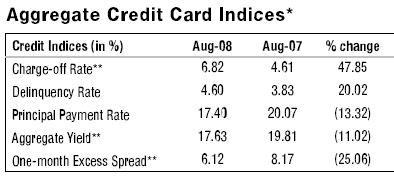
Credit card charge-off rates in the U.S. continued to rise in August and are expected to surpass the peak rate of charge-offs following previous recessions, according to Moody's Investor Services.

The charge-off rate, which measures credit card balances written off as uncollectible as an annualized percent of loans outstanding, rose 48 percent in August to 6.82 percent, compared with 4.61 percent a year ago, said Moody's in a special report.

Moody's said it expects the industry to remain under pressure through the end of 2009 as a result of the worldwide economic crisis and worsening underlying collateral performance as the credit card asset-backed securities market shows signs of increasing stress.

Although the balance sheet strength and liquidity of the sector’s largest credit card issuers remains quite strong, the uncertainty and tempo of the turmoil will test even the stalwarts’ ability to adapt.

In its mid-year report released last month, Moody's forecasted the sharp deterioration in credit card delinquency and charge-off rates. Earlier this month, Standard and Poor?'s highlighted the worsening performance in August of credit card ABS.

Monday, October 20, 2008

Hungry for success

Hungry for success

Honors students attend a graduation ceremony in Ho Chi Minh City last month.
Many among Vietnam’s young workforce say they’re eager to begin rewarding careers but are stymied by poor working conditions and low wages in the public sector. After graduating with top marks from the Hanoi University of Technology’s information technology department, Tuyen’s teacher recommended him for a job at a government-level agency. Accepting the prestigious position was viewed as a good career move by Tuyen’s family and friends. For the first three months, Tuyen had to work as an unpaid apprentice and relied on his parents for financial support. He was then put on a three-month probation at a salary of VND1.2 million (US$73.25). Like many new graduates, Tuyen accepted the low wages viewing it as a temporary hardship on the way to gaining more experience and a brighter future. But the financial struggle was harder than Tuyen had anticipated. Rent, food and petrol cost him nearly VND2 million ($122) per month. Not wanting to ask for more money from his parents, the young graduate took a second job as a part-time tutor. After two years, Tuyen’s monthly salary was increased to a mere VND1.8 million (around $110), despite the fact that he was considered a model employee and an asset to the department. It was at that point Tuyen finally decided to quit, knowing he simply couldn’t afford to live on his wages. He applied for work at a foreign information technology company and was offered a starting wage of VND9.93 million ($600) a month.
In Vietnam’s newly flourishing economy, many domestic and foreign enterprises are willing to pay tens ofmillions of dong to keep good staff. Vietnam’s governmental agencies, however, are seemingly unable to retain good talent due to a pay scale that doesn’t allow for the basic necessities of life.

Quantity over quality

After graduating with honors from Hanoi’s Institute for International Relations (now the Diplomatic Academy of Vietnam), Quynh, who speaks two foreign languages, applied to a ministry-level office. In the beginning, she was paid VND1.2 million ($73.25) per month. Like Tuyen, Quynh said the salary was not as important as the experience she thought she would gain. But Quynh’s expectations of improving her skill set and advancing her knowledge in a professional environment were soon dashed, she said. In the morning, most staff would arrive on time to avoid being entered into the latecomer list, Quynh said. But they would then gather around and chat idly instead of beginning their daily tasks. Most employees would work from 9:30 a.m. until 11:30 a.m. and then break for a two-and-a-half-hour lunch and nap. After returning, most would not begin working again until 3 p.m. and would leave promptly at 5 p.m., Quynh said. The sluggish work environment led Quynh to feel she wasn’t learning or growing and moreover, the low pay wasn’t enough to justify staying in the position. Eventually, Quynh quit the job she had initially been so eager to start. “If governmental agencies don’t change their unproductive and bureaucratic working method, and continue to appraise staff by length of service rather than by their ability and achievements, they will not be able to attract talented individuals and will also lose youths’ faith in the state sector," Quynh said.

Work ethic and nepotism

Thanh, another recent university graduate with dreams of developing a rewarding career, applied to a local research institute. The interview process was intense, she said.
Thanh was made to take several tests in English and had to demonstrate proficiency in translating and essay-writing. Despite the stress of the testing, the rigorous process led Thanh to believe the institute highly valued skills and ability from its employees – a work environment she wanted to be a part of. But when Thanh began working at the agency, she soon realized that she seemed to be the only one made to conform to its high standards. According to Thanh, the institute’s director had appointed several positions to family members, whether they were qualified or not. People’s work ethic was poor and many staff members in high-ranking positions didn’t even speak English, she said.

"It’s not that Vietnamese youth have no spirit of sacrifice but they have [nothing to show] for their contribution," said a former employee of a governmental agency.

Reported by Lan Tuong*

*The writer is a consultant for the Hanoi-based Consultancy on Development Institute, which works to enhance cooperation between public and civil sectors through lobbying policies.

Sunday, October 19, 2008

The Great Iceland Meltdown

Published: October 18, 2008


Who knew? Who knew that Iceland was just a hedge fund with glaciers? Who knew?

If you’re looking for a single example of how the globalization of finance helped get us into this mess and how it will help get us out, you need look no further than British newspapers last week and their front-page articles about the number of British citizens, municipalities and universities — including Cambridge — that are in a tizzy today because they had savings parked in Icelandic banks, through online banking services like Icesave.co.uk.

As Dave Barry would say, I’m not makin’ this up.

When I went to the Icesave Web site to see what it was all about, the headline read: “Simple, transparent and consistently high-rate online savings accounts from Icesave.” But then, underneath in blue letters, I found the following note appended: “We are not currently processing any deposits or any withdrawal requests through our Icesave Internet accounts. We apologize for any inconvenience this may cause our customers.”

Any “inconvenience?” When you can’t withdraw savings from an online bank in Iceland, that is more than an inconvenience! That’s a reason for total panic.

So what’s the story? Around 2002, Iceland began to free its banks from state ownership. According to The Wall Street Journal, the three banks that make up almost the entire banking system in Iceland “grew quickly on easy credit” and “their combined assets rose tenfold in five years.” The Icelandic banks, while not invested in U.S. subprime mortgages, had gone on their own borrowing and lending binges, wooing savers from across Europe with 5.45 percent interest savings accounts.

In a flat world, money can easily seek out the highest returns, and when word got around about Iceland, deposits poured in from Britain — some $1.8 billion. Unfortunately, though, when global credit markets closed up, and the krona fell, “the Icelandic banks were unable to finance their debts, many of which were denominated in foreign currencies,” The Times reported. When depositors rushed to get their money out, the Icelandic banking system had too little reserves to cover withdrawals, so all three banks melted down and were nationalized.

It turns out that more than 120 British municipal governments, as well as universities, hospitals and charities had deposits stranded in blocked Icelandic bank accounts. Cambridge alone had about $20 million, while 15 British police forces — from towns like Kent, Surrey, Sussex and Lancashire — had roughly $170 million frozen in Iceland, The Telegraph reported. Even the bobbies were banking in Iceland!

So think about it: Some mortgage broker in Los Angeles gives subprime “liar loans” to people who have no credit ratings so they can buy homes in Southern California. Those flimsy mortgages get globalized through the global banking system and, when they go sour, they eventually prompt banks to stop lending, fearful that every other bank’s assets are toxic, too. The credit crunch hits Iceland, which went on its own binge. Meanwhile, the police department of Northumbria, England, had invested some of its extra cash in Iceland, and, now that those accounts are frozen, it may have to reduce street patrols this weekend.

And therein lies the central truth of globalization today: We’re all connected and nobody is in charge.

Globalization giveth — it was this democratization of finance that helped to power the global growth that lifted so many in India, China and Brazil out of poverty in recent decades. Globalization now taketh away — it was this democratization of finance that enabled the U.S. to infect the rest of the world with its toxic mortgages. And now, we have to hope, that globalization will saveth.

The real and sustained bailout from the crisis will happen when the strong companies buy the weak ones — on a global basis. It’s starting. Last week, Credit Suisse declined a Swiss government bailout and instead raised fresh capital from Qatar, the Olayan family of Saudi Arabia and Israel’s Koor Industries. Japan’s Mitsubishi bank bought a stake in Morgan Stanley, possibly rescuing it from bankruptcy and preventing an even steeper decline in the Dow. And Spain’s Banco Santander, which was spared from the worst of this credit crisis by Spain’s conservative banking regulations, is purchasing America’s Sovereign Bankcorp.

I suspect we will soon see the same happening in industry. And, once the smoke clears, I suspect we will find ourselves living in a world of globalization on steroids — a world in which key global economies are more intimately tied together than ever before.

It will be a world in which America will not be able to scratch its ear, let alone roll over in bed, without thinking about the impact on other countries and economies. And it will be a world in which multilateral diplomacy and regulation will no longer be a choice. It will be a reality and a necessity. We are all partners now.

Friday, October 17, 2008

YouTube Founder Compares Online Video To Nascent TV Market

http://www.techcrunch.com/2008/10/16/youtube-founder-compares-online-video-to-nascent-tv-market/

by Michael Arrington on October 16, 2008


YouTube Cofounder Chad Hurley spoke at the MIPCOM Conference in Cannes, France yesterday.

In the talk, which is transcribed below, Hurley compares the current state of online video to the nascent years of television. In 1941, he says, “CBS has just launched its new television network amidst cries that it means the death of radio.” Advertisers were hard to come by. Content owners were afraid of alienating their existing audiences. etc.


A Brave New World - The Future of Managing Content

I would like to share with you a quick story that many of you may already know.

A small group of innovators introduce a new technology that has the ability to entertain and engage people on a massive scale. Advertisers willing to risk money on this untested platform are hard to come by. Content owners are reluctant to embrace it for fear of alienating their existing audiences. And experts hail this new platform as signaling the demise of another.

As some of you may have guessed, this is not only the story of YouTube. The year is 1941, nearly 70 years ago, and CBS has just launched its new television network amidst cries that it means the death of radio.

From the printing press to the blog, from the record player to the iPod, and from the stage to the home theater, the way content has been produced, distributed and consumed in the world is constantly evolving.

The challenges we face today are not new. Today, my keynote kicks off the digital portion of this conference. I would argue that the difference between this part and the part that preceded it is semantics. We are all - digital or otherwise - confronting the same challenges and we should all be searching together for common solutions. We must embrace this new chapter, as those that came before us embraced theirs 67 years ago.

The digital age has brought with it great change and great challenges; to some it brings the goal of global content distribution closer. For others it represents a loss of control and maybe the loss of a business model. As this era accelerates – as content moves from controlled to distributed, as we migrate from a single platform delivery model to multi-platform delivery, as the world changes around us – we need to ask ourselves: can and will we adapt to this new paradigm? Are we the drivers of change, or will change drive us?

I am here to say that we want to continue to be your partner. We want to continue to work with you – the content owner – to make smarter, more informed decisions about managing and distributing your content. Many of you have already recognized the power of online digital distribution. Companies like CBS, the BBC, HBO, Sony BMG, North One and AFP just to name a few, have already joined us. In fact, yesterday we announced a major partnership with RAI, one of Europe’s biggest broadcasters. Italians have been passionately embracing our platform, discussing current affairs and enjoying performances from local talent. With RAI on board, users will be able to watch some of the most popular professional Italian content on their computer screens. And today, we are happy to announce a partnership with European powerhouse Panini. We look forward to working with both companies to provide the online content their audiences are demanding.

For those of you wary of this new, decentralized distribution model, understand that the technology exists to give you the control you need. And by opening your content to digital distribution, as so many content providers have already done, you gain unprecedented reach and scope to touch new audiences around the world, anywhere and anytime. If you embrace this opportunity, you will evolve your business model and find new channels and opportunities to deepen engagement, discover new viewers and find new, substantial revenue opportunities.

Ultimately, we all need to embark on this journey together. We cannot retreat from technological advances. Even if YouTube didn’t exist, other platforms would surely be driving this change.

There was a time when a centralized distribution model was relevant and effective. But if you listen to your audience; if you hear what they are telling you; you will understand that the days of the centralized distribution hub are ending. Your audience – today’s consumers – want access to content on PCs, TVs, mobile phones and social networking pages. And contrary to what some believe, the internet doesn’t take viewers away from traditional broadcast. As the President of NBC Research told the New York Times a few months back: “The Internet hardly cannibalizes; it actually fuels interest.” In fact, reacting to a recent Forrester study focused on engaged viewers of online video, executives from ABC, CBS and MTV all agreed that online video was adding to their total viewership rather than taking away from it. So the question before you today is: do you circle ranks and push back against the surge of change? Or, do you open yourselves to the promise and possibilities of globalized content everywhere at anytime on any device?

This world may appear chaotic, but it can be harnessed to your advantage if you’re willing to think outside the single platform delivery model. We need to continue to work together and find ways to open your content to the world, and do so with the standards, protections and strategy in place that gives you control and satisfies your audiences. Opening your distribution will give you a greater presence than ever before. And you will be able to manage your content in a way that generates new channels of revenue and taps into emerging and explosive markets, in the same way that companies like CBS and RCA, under the leadership of visionaries like David Sarnoff, did so many decades ago.

This new world is not without its challenges. The concerns that some of you have are very real. Does digital distribution mean that you lose control? What about the quality of online content?

Does the digital distribution model make sense? These are all valid and familiar questions.

The truth is that the long-anticipated convergence of TV and the computer is happening faster than anybody predicted. It’s happening now. Let’s look at just a few data points on this:

- Around 10 billion videos are viewed monthly online in the U.S. alone
- On YouTube 13 hours of content are uploaded every minute
- The number of people consuming video on their PCs is higher than ever before
- In France over 120 million hours of video content is watched per month while over 3 million mobile phone subscribers use their phone to view a video

So online video is here to stay and evolving faster and in more dynamic ways than anyone imagined, even a few years ago. As for the business questions: the market potential of online video distribution may be in its early stages, but it’s here and growing fast.

- The online video advertising market is set to be worth over a billion dollars by 2010, will reach over $3 billion by 2012, and over $5 billion by 2013

People want solutions for searching, discovering, watching, and interacting with video. And you, as content providers, are looking for new audiences and new revenue channels. Given these demands, how can we take advantage of this massive market opportunity?

Let’s recognize that video captures the visceral, dynamic quality in life and shares it with the world. This has driven YouTube’s exponential growth in the last two years. Again, 13 hours of video are uploaded to YouTube every minute. That’s the equivalent of Hollywood releasing more than 57,000 full-length movies every week. Hundreds of millions of people come to YouTube every month to search, discover and share this content with their friends.

For you, the content owners, online video provides big opportunities across the 4 Rs: Reach, Research, Revenue, and Rights Management

First, online video provides massive and targeted reach to hundreds of millions of viewers. And we’re making those videos and communities even easier to discover. Online video also provides content owners with an opportunity to extend their brand, reach new consumers, and tap new revenue opportunities, which I’ll discuss later. For this group, online video provides the benefit of longer viewer engagement with greater frequency across multiple channels.

In August of this year the International Olympic Committee launched nine Channels on YouTube. Through our platform, the IOC offered this year’s Summer Olympic Games to a truly global audience across 78 territories in Asia, Africa and the Middle East for the first time in Olympic history. Hundreds of millions of people around the world were able to engage and experience the Olympics online, many of whom never had never had the opportunity to see the Games on their televisions. All of this took place while NBC, the broadcaster that owned the rights to the Olympics in the US, effectively used our Video ID technology to monitor and quickly block copyrighted Olympic content uploaded to the site.

Second, research provides a new breed of analytic tools that dive into who, why and where your content is being watched.

The products and features being developed by online video providers continue to evolve. For example, the American rock bank Weezer launched their music video “Pork and Beans” on YouTube resulting in over 4 million views in just two days. Using our sophisticated analytics tool, the band was able to then get an in-depth look at the video’s views. This data provided an online focus group of sorts, enabling them to prepare more effective and powerful marketing campaigns. It even helped Weezer understand where their videos were being watched and then plan their upcoming tour.

And third, global distribution and analytics tools give advertisers and content owners fresh channels of revenue on new and existing forms of content. Advertisers want simplicity with reach. Online video does this by combining reach beyond TV, with the targeting, reporting and accountability of sophisticated online advertising tools and analytics. Online video began as a playground for advertisers where they could test ideas, drive brand awareness and create consumer engagement through clever viral video campaigns. In the current economic climate, this platform also provides advertisers with an affordable distribution channel and metrics to help gauge the success of a campaign and drive engagement numbers up.

As some of you may have heard, last week we announced a groundbreaking deal with CBS to test full-length feature programming on YouTube. We also designed a new video player to provide the best possible user experience when watching this long-form content. With nearly 80,000 subscribers in their Channel and 250 million views, CBS has received a strong, positive response from the YouTube community around the quality of its programming. Under the terms of this latest deal, CBS has added more than 80 full-length shows to their Channel, complementing the more than 9,000 short-form videos already available. CBS will be selling its own advertising inventory on YouTube. This arrangement allows CBS to aggregate their ad inventory across the web to increase their reach and levergae the strength of their sales force.

An then there’s the fourth “R”. And I wouldn’t want you to think I’ve forgotten that one. Of course, I’m talking about rights and rights management. From the very beginning, we’ve been committed to working with content owners to make sure YouTube remains a platform for distribution, not unauthorized uploads. In fact, over 300 media companies, including NBC, RAI, Formula One, the Olympics and Lionsgate are using innovative products like YouTube’s Video Identification tool to better manage their presence on our site. Along with the other tools in our Content management system, Video ID helps content owners decide whether to block, promote, or even generate revenue from their content.

The European Commissioner for information, society and media, Vivian Reding, recently hailed YouTube as a great example of how content producers and service providers can work to benefit each other through our Video Identification technology, saying: “The Youtube platform tells the rights owner if his content has been uploaded to Youtube. He then has a choice: leave it up as it is, add advertising - thus monetizing the content- or requesting that the content be taken down.” I couldn’t have said it better myself. And we will remain committed to introducing these types of protections tools in the future.

Ultimately, the online video experience is about empowerment. Consumers of online video are empowered to be their own content programmers, consuming the relevant mix of mass, niche and personal media they demand. Advertisers are empowered through data to better understand and engage with their audiences. And content owners are empowered, through sophisticated identification tools, to control their content and make smart business decisions with their content.

The proliferation of content will continue exponentially. And as methods for uploading, aggregating, personalizing and distributing digital content develop, content owners will find new challenges and business opportunities. Spurred by technological innovation, people are already looking beyond their laptops to upload, customize and distribute content from and to any device.

Video content delivered to mobile devices will open consumers, advertisers and content creators to a world of opportunity. Everything from movie watching and sharing to hyper-targeting and dynamic, interactive, location-relevant ads are emerging within the mobile market. As the Web grows, so will videos’ presence in it. Accelerated by the power of embeddable video, developers will find new, innovative ways to push the boundaries of how ads are served and watched online. And the jump from the desktop to the TV, or the phone to the TV, or the camera to the TV, will all become seamless.

Gaining control of online video content and discovering effective business models are vital not only for our growth, but for our common survival. Online video is already fully integrated into the fabric of the Web – its presence is universal, inspiring and empowering to all that embrace it. In the very near future, the distribution of online video will soon cease to be seen as a threat, but rather as a fundamental distribution solution that can be personalized on desktops, phones and tv’s alike.

Where we are today is not the YouTube era. It is not the digital content era, or the multi-platform era. Where we are today is an extension of the work you have all done, built on the shoulders of CBS, RCA and the other innovators who came before us. There is no old media. There is no new media. There is one media with one common purpose: to inform, move and inspire the world through information, art and entertainment. Together, we can find a solution that will benefit everyone in this ecosystem, from consumers to advertisers to the content owners alike.

Thank you very much.

YouTube Founder Compares Online Video To Nascent TV Market

http://www.techcrunch.com/2008/10/16/kaixin001-chinas-apple-of-social-networks/

by Guest Author on October 16, 2008

Editor’s Note: This guest post was written by Alan Rutledge, who formerly worked as a developer for Idealab, the startup incubator behind Google Picasa and Yahoo Overture.


Kaixin001, the latest newcomer to the Facebook clone wars in China, is China’s fastest growing social network having amassed a staggering 7.5 million users in the first 5 months since it launched in May 2008. The site tripled Twitter’s traffic reach in the month of September alone and is currently the 250th most popular site on Alexa worldwide.

Compared with rival incumbent Xiaonei, which targets college students, Kaixin001 appeals to white-collar office workers with a simpler UI that is more intuitive to older audiences. This is a significant detail in China, where one in four college students does not own a computer and can only access Xiaonei by walking to an Internet Cafe and paying by the minute. White-collar office workers by comparison, spend an average of nine hours a day in front of the computer.

Kaixin001 succeeds simply by cloning only the most successful Facebook applications and bringing them to the Chinese market before anyone else. Examples of viral hits that they have cloned are:

  • Friends for Sale: Females have an unfair advantage in this game thanks to China having one of the highest male-to-female ratios in the world.
  • Parking Wars: Ironically most people in China can’t afford a real car, which makes this game all the more compelling.
  • iLike: Up until recent crackdowns, the Chinese equivalent allowed you to upload and share your entire music collection with your friends.
  • Where I’ve Been: This application defaults to a province map of China because most people have never left the country.

A non-clone worthy of note is Online Storage, a cloud-based file sharing application that harks back to Facebook’s early forays into peer-to-peer file sharing, when Sean Parker of Napster-fame was still president of the fledgling startup.

Blatant cloning may be shunned in the Valley, but in China and other parts of the world, cloning is the expectation of financial backers who benefit from the lower investment risk profile. Being too slow to clone has in fact hurt Xiaonei, which is now being overshadowed by Kaixin001’s 90% month-to-month growth rate.

As a fledgling 20-man startup with limited resources, why does Kaixin001 develop all of its apps? At a time when the Western World is embracing open web platforms, this approach strikes us as counter-intuitive and even backwards. Chinese web platforms, however, face several critical issues:

  • Limited access to capital: Venture capital is scarce in China. By comparison, close to a quarter billion dollars has been pumped into Facebook applications to-date.
  • Weak online ad markets: Chinese web companies rely heavily on virtual goods and micro-transactions; neither model works for most of Kaixin001’s applications.
  • Rampant software piracy: There are proportionately fewer developers available to build 3rd party applications in China due to limited job opportunities as a direct result of piracy keeping the market for software stagnant.
  • The Language Barrier: Most open source languages and documentation are available primarily in English. Chinese people who would otherwise make good programmers struggle with this additional hurdle.

The 700 third-party applications on Xiaonei have a huge variability in quality. Kaixin001 has only 25 applications, yet it retains complete control over quality and and has the speed and focus needed to bring well-tuned viral hits to the Chinese market faster than its competitors—perhaps the better strategy in hindsight.

Hundreds of thousands of people quite regularly visit kaixin.com instead of the correct kaixin001.com domain name. Recently, Xiaonei’s parent company purchased the kaixin.com domain name with plans to launch a Kaixin001 clone that would steal its rivals users. This effectively makes Kaixin a clone of a clone of a clone. Amazing.

Kaixin001 was founded by a former executive from Sina.com (the Yahoo! of China) and recently closed a $4-5 million first round from Northern Light Venture Capital.

get widgetminimize
Xiaonei image
Website: xiaonei.com
Location:China
Acquired: October 24, 2006 by Oak Pacific Interactive

Xiaonei.com is a Chinese Facebook clone that was acquired by Oak Pacific, a Chinese internet consortium for an undisclosed sum. The site mimics… Learn More

Kaixin001 image
Website: kaixin001.com
Founded: April, 2008
Funding: $5M

Kaixinwang (Kaixin001) is a China-based, Facebook-clone social networking site. Kaixin allows for photo uploading, a blogging and micro-blogging platform, music sharing, and a 1G online hard drive. Learn More

Wednesday, October 15, 2008

Three Years Later, Buying MySpace Looks Like One Of Murdoch’s Smartest Bets

by Erick Schonfeld on October 15, 2008

Three years ago today, Rupert Murdoch bought MySpace and its parent company Intermix for $580 million. That turned out to be money well spent. The last time we ran the numbers, we figured that MySpace alone is worth between $3 billion and $20 billion, depending on how much you value each user. Fox Interactive Media (which is mostly MySpace) accounted for about $850 million in revenues last fiscal year (which ended in June), and is projected to hit $1 billion next year.

It was supposed to hit $1 billion this year, but never mind. Unlike other social networks, MySpace is actually making a profit. The company now employs 1,600 people worldwide, compared to 150 in October, 2005—more than a tenfold increase.

The social network has grown as well. MySpace now has 73 million unique visitors a month in the U.S., according to comScore, compared to 24 million three years ago. (Facebook has 41 million). That means MySpace reaches about 40 percent of the online population, compared to 14 percent three years ago. Those visitors, on average, spend 263 minutes a month each on the site, versus 83 minutes in 2005.

MySpace has definitely evolved since 2005. Just this year it has made major strides in opening up its platform to developers, launching MySpace Music, and pushing new forms of social advertising.

The question is whether rival Facebook can catch up to MySpace in the U.S. (it has already surpassed it worldwide), or whether the two will co-exist and diverge, with MySpace being more music- and media-oreinted and Facebook continuing on its path towards becoming the platform for social software. Of course, MySpace would also like to play that role.

Three years from now, which one will be worth more? And will Rupert Murdoch still be smiling?

Thursday, October 9, 2008

Canada is Not China

Quote du Jour: Canada is Not China

Canada is not China.

-- An anonymous ex-Fed official explaining U.S. eagerness to find Canadian buyers for U.S. banks. "Fed Trolls Canada to Rescue U.S. Banks"

Wednesday, October 8, 2008

Fed, major central banks slash rates

LONDON (MarketWatch) -- The U.S. Federal Reserve, the Bank of England, the European Central Bank and other major central banks all moved to slash key interest rates Wednesday as they struggle to head off global financial turmoil that has threatened to throttle world economic growth.
In coordinated announcements, the Fed said it had cut its key lending rate by a half point to 1.5%.

In similar moves, the Frankfurt-based European Central Bank trimmed its key refi rate to 3.75% from 4.25%, while the Bank of England cut its key rate to 4.5% from 5%.
"Incoming economic data suggest that the pace of economic activity has slowed markedly in recent months," the Fed said, in a statement. "Moreover, the intensification of financial market turmoil is likely to exert additional restraint on spending, partly by further reducing the ability of households and businesses to obtain credit."

The Bank of Canada, the Swedish Riksbank and the Swiss National Bank also cut rates. The Bank of Japan didn't join in the coordinated move.

The Fed said that while inflation has been high, the rate-setting Federal Open Market Committee believed that the decline in energy and other commodity prices and the weaker prospects for economic activity have reduced the upside risks to inflation.
The Fed also approved a 50 basis point cut in the discount rate to 1.75%.

Tuesday, October 7, 2008

FEATURE-Irrigation advances fuel Cambodian rice dream

10.07.08, 8:04 PM ET
Cambodia - By Ek Madra
TRAMKOK, Cambodia, Oct 8 (Reuters) - Sok Sarin flashes a toothless grin as he looks at his newly built house and remembers how the other farmers laughed when he pioneered new rice-growing techniques in his district in southern Cambodia.
Better irrigation, training in how to select seeds and cheap fertiliser made from wild plants and animal or bat droppings have more than doubled the yield from his rice fields to 3.4 tonnes per hectare from 1.5 tonnes.
"No one believed that this idea would work. Now they follow me and they have good harvests," said Sarin, 60.
Cambodia's economy was devastated by civil war from the 1970s to the late 1990s, including four years under Pol Pot's Khmer Rouge, whose dream of transforming the country into a great rice power ended in the nightmare of the "Killing Fields".
Now another agrarian revolution is under way as the government seeks to boost rice exports and cut poverty among its 14 million people, 85 percent of whom are farmers or members of farming families.
Thanks in large part to vastly improved irrigation, Sarin can get two crops a year from his fields, earning him an income of $1,500. Per capita income in Cambodia is around $500.
Sarin's neighbour, Long Yos, 50, said Cambodian farmers were also following methods honed in China, India and the Philippines to breed fish that eat the insects that destroy rice plants.
"The fish eat the insects; we eat the fish when they get bigger," said Yos.
OVER-AMBITIOUS
Better irrigation and the expansion of land use are crucial to government ambitions to produce 15 million tonnes of rice by 2015, more than double the 7 million forecast for 2008/09 and 6.76 million in 2007/08. The main harvest is in November.
According to the U.S. Department of Agriculture (USDA) Cambodia was the world's ninth-biggest rice exporter in 2007 with 450,000 tonnes. Agriculture Minister Chan Sarun says Cambodia could export 8 million tonnes by 2015.
Neighbours Thailand and Vietnam were in first and third places in the export table in 2007 with 9.5 million tonnes and 4.5 million tonnes respectively, according to the USDA.
One rice dealer with a trading house in Singapore estimated Cambodia exported 600,000 to 800,000 tonnes a year, directly or indirectly via Thailand, and could push that up to 1.5 million tonnes in one or two seasons if the government was focused.
"But 8 million tonnes is an entirely different ball game. Obviously, this has to come from increases in area and not just yield," he said.
Another Singapore trader said it would take a lot of money for Cambodia to push yields significantly higher.
"China is the only country in the developing world that has reached 6 to 8 tonnes per hectare. Thailand is at 3.5 tonnes per hectare while India is around 2.5 tonnes," he said.
Analysts in Thailand, while acknowledging how far Cambodia has come already, think its plans are just too ambitious.
"It's possible, but it would not be that easy," Paka-on Tipayatanadaja at Kasikorn Research said of the 2015 target.
"It would take more than a decade to develop not only an irrigation system, but also a logistics system and storage systems," she added.
IRRIGATION
Many Cambodian farmers harvest just once a year because of a lack of water. Vietnam and Thailand, with their superior irrigation, manage two or three crops.
Phnom Penh is investing about $49 million a year on irrigation, said Hang Chuon Naron, an official at the Finance Ministry, but much more is needed.
"Japan and South Korea are helping us but that's not enough," said Chea Chhun Keat of the Water Resources Ministry, adding 1.6 million hectares of 2.6 million under cultivation was irrigated.
Foreign investment is flowing into Cambodia thanks to its cheap labour and the political stability achieved under Hun Sen, prime minister since 1985.
In August, Kuwait agreed loans totalling $546 million, of which $486 million will be invested in irrigation systems and hydro-power on the Stueng Sen river in the northeast of the country.
A Kuwaiti newspaper said Kuwait had leased rice fields to secure food supplies. Qatar also plans to invest $200 million in Cambodian farmland.
"They have the money, we have the land. They wouldn't come if we didn't have agricultural potential," said farm minister Sarun.
Land under cultivation could be pushed up to 3.5 million hectares quite quickly, according to Yang Saing Koma, president of the Cambodian Center for Study and Development in Agriculture.
He pointed to the area round Tonle Sap, Cambodia's biggest freshwater lake with up to 800,000 hectares of potential farm land, much of it unused as a lack of irrigation means farmers can't control water levels: In the rainy season, there's too much, which damages rice plants, in the dry season too little.
There is more land to be worked in the northeast and in the still-mined former battlefields of the northwest.
In all, Saing Koma said, Cambodia had 6 million hectares that might be cultivated for rice and other crops.
The average rice yield per hectare is currently 2.6 tonnes and he said that could be pushed up to 3.5 tonnes -- a yield that Sarin has in his sights thanks to the training, irrigation and bat droppings that have given him two crops a year. (Writing by Alan Raybould; editing by Megan Goldin)

Friday, October 3, 2008

Now the Hard Part - Thoughts from Sam Palmisano, President and CEO of the IBM Group

This is pulled from the the August 2008 edition of the Vietnam Economic Times

The fourth challenge is the toughest of all; winning and hearts and minds. Not primarily of the CEOs and heads of state - they are not the problem. It's not the other management layers, the people who make decisions at the regional and agency levels - and especially the public at large: communities, individuals and populations that do not yet see themselves as the beneficiaries of global integration.

To do that, to make that case, we will need fact-based, reasonable, multilateral approaches. And one other thing: we must recognize that the opposition to global integration really does have a point when it comes to environmental, economic and societal impacts; to job creation, education and skills; to access to connectivity and other resources; and to the inherently global problems of crippling energy costs, unsafe drinking water and pandemic-scale disease. We may differ on the best solutions to these problems, but we can't just keep saying, "Free trade! Free trade!" and think will carry the day. We can't rely on arguments from 1990 or, for that matter, 1890.

This will require multi-disciplinary, cross-boundary dialogue and approaches - not only in business but also in national and geopolitical action and decision making. The problems and the solutions of the global commons, the flattening world, by their very nature cross those old boundaries. We must, too.

Over the past decade we have witnessed a great debate on how societies should deal with competition, conflict and opportunity on a planet that is rapidly integrating. Within policy circles this is often framed as the debate between the so-called "realists" - those who look out and see a future of multiple competing nation-states, where the job at hand is to acheive a "balance of power" - and another view that foresees the rise new superpowers, with one or another of them ultimately achieving dominance.

Neither of those perspectives seems particulary hopeful to me - nor does either of them seem truly global. Happily, over the past few years, a "third way" has emerged. It's often called "soft power" or, more recently, "smart power."

I can attest to the efficacy of this approach. My own company, IBM, was once the paradigm of a business "superpower". We dominated our industry. But such dominance is always fleeting, and outs fled. Yet, unlike most empires that fall, we didn't disappear. Instead, we asked very hard questions, made very hard decisions and reinvented ourselves - becoming far more open, far more collaborative and far less hierarchical.

To me, that's "smart power" within a particular company, and in the world of business.

Wednesday, October 1, 2008

Google Launches Its Own Memetracker

http://www.techcrunch.com/2008/10/01/google-launches-its-own-memetracker/

by Jason Kincaid on October 1, 2008

Google has just launched a new homepage for its blog search that bears a strong resemblance to Techmeme, Memeorandum and their “memetracker” counterparts. The site displays a listing of the top stories from across a variety of topics including business, politics, technology, and entertainment.

Memetrackers identify emerging trends on the web, especially across blogs. They are often the best way to learn about breaking news stories, as they can automatically monitor hundreds (or more) news sources at once. Major news outlets and user-submitted content sites like Digg often trail memetrackers by days.

Google may well be able to leverage some of the technology it has developed for Google News, which identifies emerging news stories across thousands of sites run by newspapers, television stations, and other media sites. But at this point it’s too early to tell if Google Blogsearch will be more useful than any of the other memetrackers (or if its even in the same league). Much of its utility will lie in how often the listings are updated, how many sources it pays attention to, and how it assesses a blog’s credibility - a memetracker is only as good as the stories it presents.

Google may be able to create a useful tool, but that may not be enough to overcome the established leaders in this space. In 2007 the New York Times launched its own TechMeme killer, which has largely been ignored. There’s something about TechMeme which keeps bringing people back to it.